Bowie, Maryland
Bowing Wall Repair in Bowie, MD
Bowing Wall Repair in Bowie, Maryland, with published price ranges up front, the movement measured and the cause named on site, and one written figure before any work begins.
Bowie, Maryland
Bowing Wall Repair in Bowie, Maryland, with published price ranges up front, the movement measured and the cause named on site, and one written figure before any work begins.
A basement wall should stand straight. When one starts to curve inward, usually near the middle of its height, soil pressure outside has begun to win against the wall, and Bowie clay makes that contest unfair in wet years because saturated clay grows heavy and pushes hard. We repair bowing walls across Bowie, measuring how far the wall has moved before choosing how it gets held or brought back.
Movement amount drives everything. A slight bow that stopped years ago behaves differently from one that creeps inward each spring, and the repair suiting the first can be far too little for the second.
Hydrostatic pressure is the headline cause. Rain soaks the backfill beside the foundation, the clay holds that water, and the saturated mass presses far harder than dry soil. Belair homes built in the 1960s carry extra exposure, since many of their block walls went up without the reinforcement common later, and their shallow footings sit in the zone where this clay swells and shrinks.
Cracks advertise the process early. Horizontal cracking along a mortar joint near mid height is the classic sign, often joined by stair step cracks near the corners, and catching a bow at that stage keeps more repair options open.
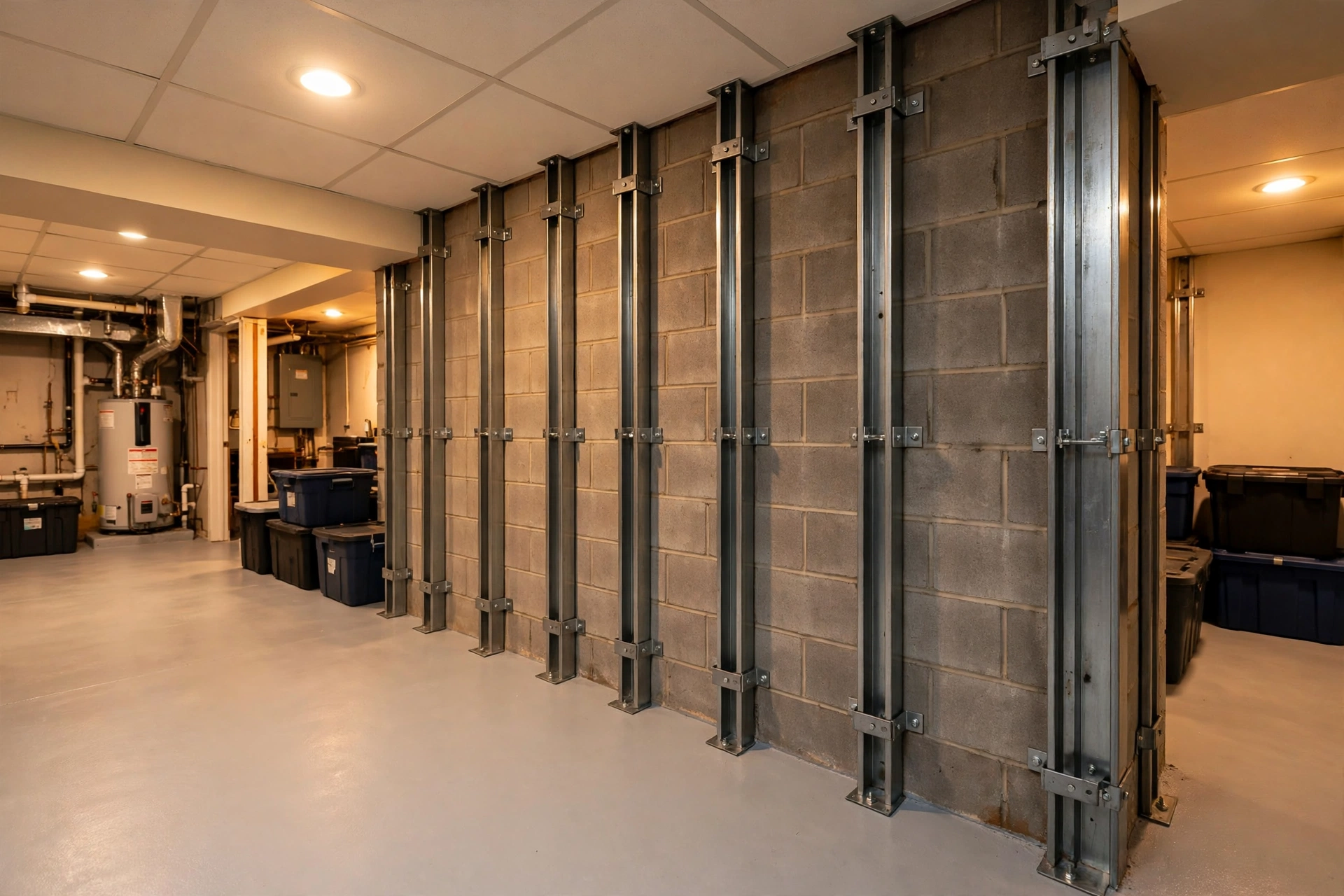
Stabilization comes first in every scope, since a moving wall must be stopped before anything else matters. Depending on measured deflection and wall construction, that hold can come from carbon fiber straps adhered down the wall face, steel I beams braced between floor and joists, or anchors tying the wall back into stable soil beyond the backfill.
Straightening is a separate question, answered honestly. Some walls can be eased partway back during anchor work, while others are best held where they stand, since forcing an older block wall back can crack it further. The site visit states which outcome fits your wall before work begins. Structural work of this kind in Bowie is permit work through Prince George's County DPIE, a market fact for foundation work in this county.
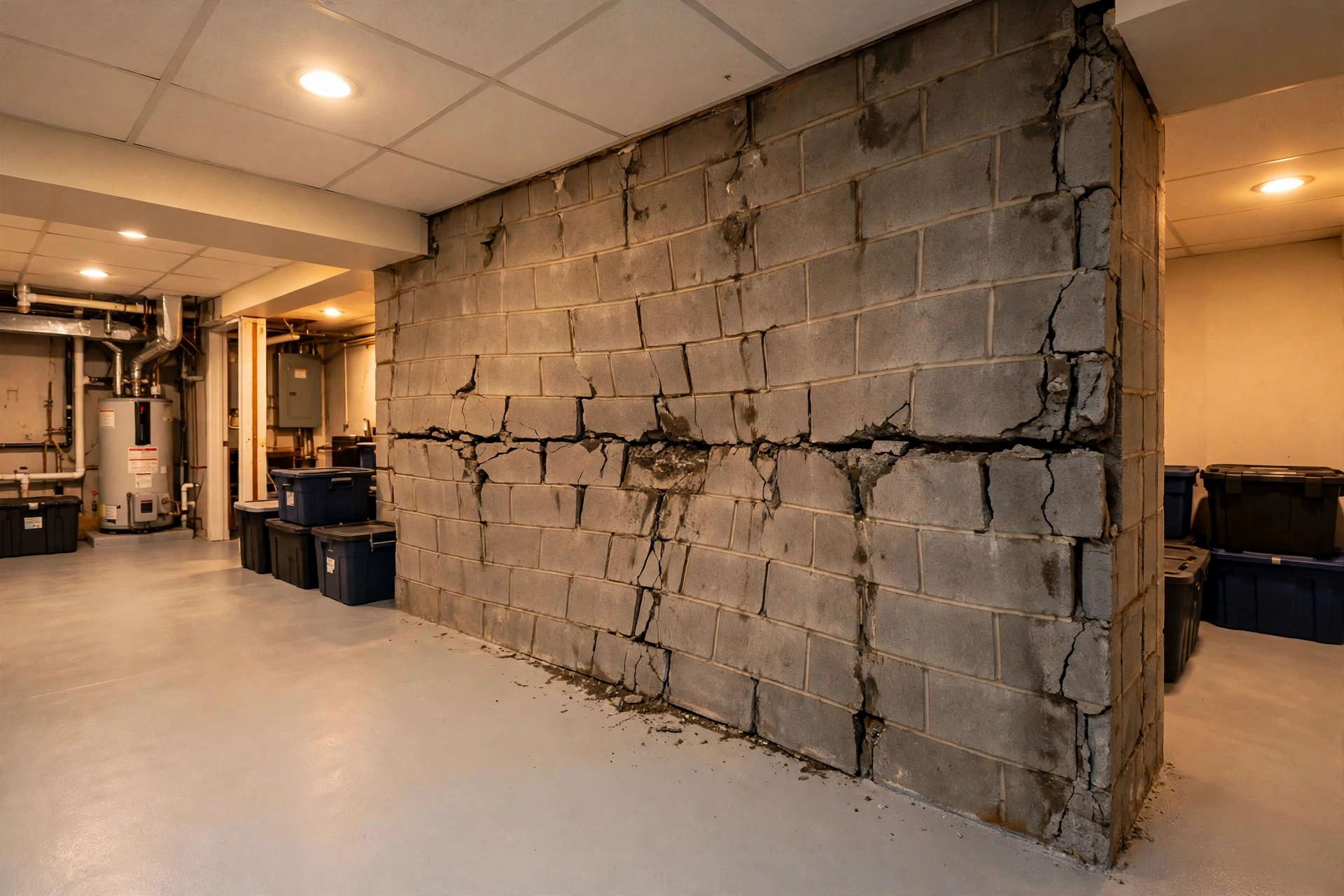
A Fairwood basement wall had bowed inward along its longest run, with a horizontal crack open at mid height and stair step cracking at both corners. We measured the deflection at several points, then installed steel I beams along the wall, braced above and secured at the base, to stop further movement. The cracks were sealed once the wall was held, and the downspout discharge on that side was extended away from the foundation.
The figures here are published figures and our Bowie band, labeled as such, since no Bowie company publishes a local price list. Bowing wall repair in Bowie generally runs $4,600 to $11,900. Wider anchors frame the market: a Modernize Maryland table puts foundation repair overall at $2,800 to $9,500, and published national guides put the average at about $5,166 to $5,174.
Within the $4,600 to $11,900 band, method and wall length set the figure. Straps along a short wall sit low. Beams or anchors along a long wall sit higher, and a wall moved far enough to need partial rebuilding leaves this band altogether.
Homeowners often ask whether a bowed wall can wait. Some can, briefly, with monitoring, and the difference is whether the wall is still moving. Marking crack ends with a pencil line and a date, then checking across a wet season, gives real evidence either way.
Our Bowie band is $4,600 to $11,900, set mainly by the stabilization method and the length of wall involved. Published guides put the national average at about $5,166 to $5,174, and a Modernize Maryland table lists $2,800 to $9,500 for foundation repair overall.
Both outcomes exist, and the wall decides. Some walls can be drawn partway back during anchor installation, while older or heavily moved walls are safest held in place, since forcing one back can crack it.
No single method wins everywhere. Carbon fiber straps suit modest movement, steel beams suit walls needing a rigid brace, and anchors suit walls tied back into stable soil. Measurement picks the method.
Any bow deserves measurement, and concern rises sharply once deflection passes an inch or keeps growing between seasons. The trend matters as much as the current number.
Cracks are sealed once the wall is stabilized, because sealing them earlier only hides the evidence while movement continues. A section too damaged to hold may need rebuilding.
The stabilization system carries the load going forward, and drainage correction lowers the pressure that caused the bow. Keeping discharge lines extended away from the house protects the repair.
Tell us what your foundation is doing. We read every request that comes in and respond with the published range for that kind of work and the next step, starting with a visit to measure the movement and find its cause.
Prefer to talk it through first? Send the form and we will call you back at the number you give us.