Bowie, Maryland
French Drain Installation in Bowie, MD
French Drain Installation in Bowie, Maryland, with published price ranges up front, the movement measured and the cause named on site, and one written figure before any work begins.
Bowie, Maryland
French Drain Installation in Bowie, Maryland, with published price ranges up front, the movement measured and the cause named on site, and one written figure before any work begins.
Some Bowie yards never really dry out. Rain leaves a soggy strip along the side lot, water stands against the foundation after every storm, and the low corner of the lawn turns to mud that lasts for days. A french drain answers that pattern directly, collecting water in a gravel filled trench and carrying it in a buried pipe to a better exit. We install french drains for Bowie homes where moving water through the yard solves the problem at its source.
Clay is the reason these drains earn their keep here. Bowie soil absorbs water slowly, so rainfall lingers near the surface and migrates toward the lowest structure nearby, which is usually the house.
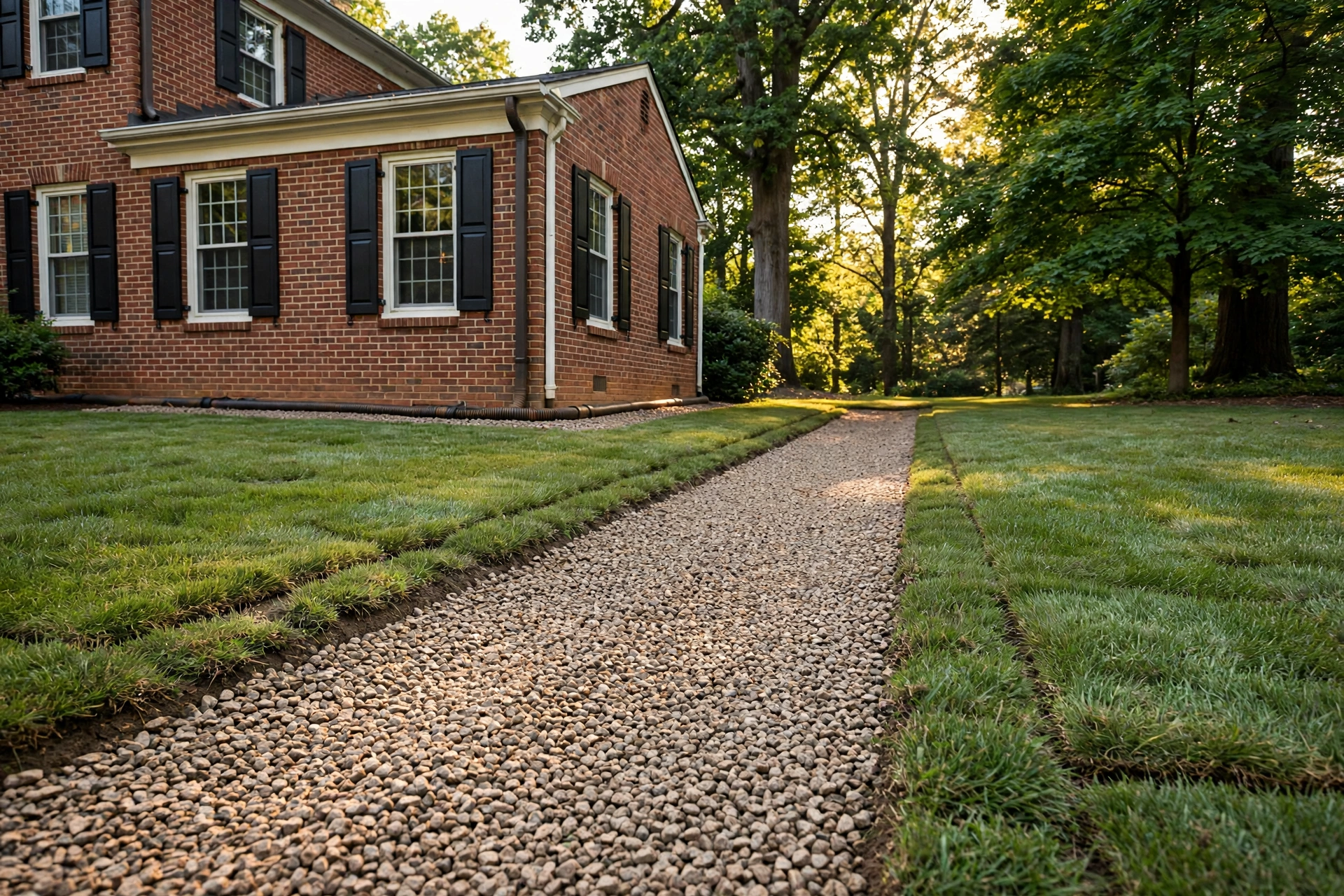
Construction is simple to describe and exacting to get right. A trench is dug along the path the water needs to travel, lined to keep clay from migrating into the stone, then filled with clean gravel around a perforated pipe set at a consistent fall. Water enters the gravel, drops into the pipe, and flows by gravity to a daylight outlet.
Slope does all the work, which makes slope the whole craft. A run that falls steadily moves water even in a moderate rain, while a belly or level stretch lets silt build and the drain fail years early. Each run is checked for fall before gravel covers the pipe, because that check is impossible to redo cheaply later.
The jobs sort into a few clear types. A yard drain run crosses the soggy area itself, gathering surface and shallow groundwater where it collects. A curtain drain sits uphill of the house, cutting off water traveling toward the foundation. A foundation run follows the wall, relieving the saturated strip that keeps a basement damp.
Pointer Ridge lots often suit a curtain or yard layout, since there is room to intercept water at a distance and a lower corner to discharge toward. Tighter Belair lots may call for a foundation run tied into the downspout plan.
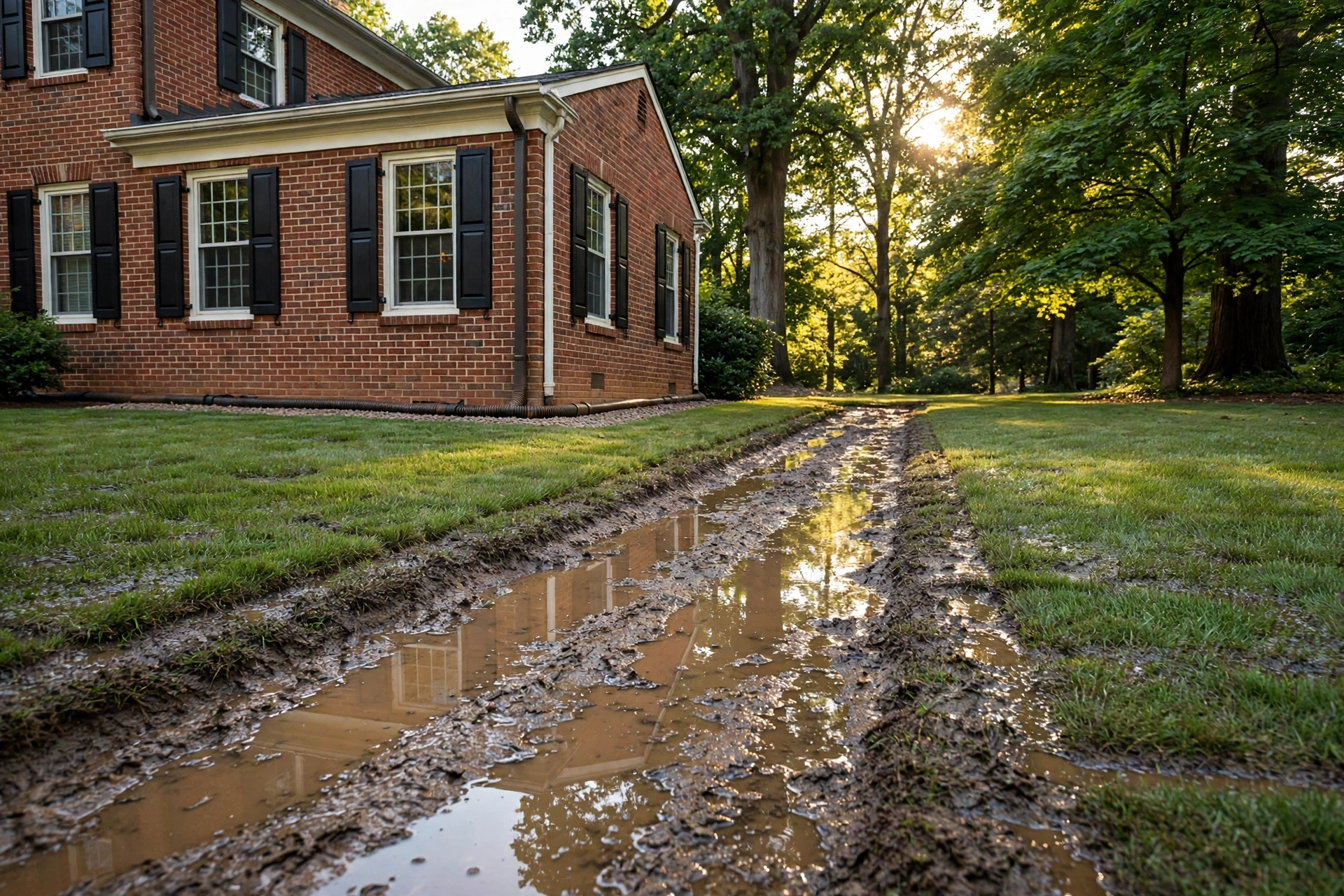
A Pointer Ridge yard held water along its side lot line after every rain, and the strip beside the foundation stayed saturated for days, keeping the basement wall on that side damp. We dug a curtain drain run across the uphill side of the lot, set a perforated pipe in clean stone at a checked fall, and carried the line to a daylight outlet at the lower rear corner. The trench was backfilled and the lawn strip restored over the run.
No Bowie company publishes a local price list, so the figures here are published figures and our band, labeled as such. French drain installation in Bowie generally runs $2,400 to $5,900. A wider published anchor for comparison is a Modernize Maryland foundation repair range of $2,800 to $9,500, though a yard drain prices on its own route and conditions.
Length is the first driver inside the $2,400 to $5,900 band, with depth, discharge method, and surface restoration behind it. A short run to an easy daylight outlet sits low, while a long deep run sits higher.
A well built drain asks little, but not nothing. The outlet needs to stay open and visible, since mulch and soil creep can bury a daylight exit over a few seasons.
Our Bowie band is $2,400 to $5,900, driven mainly by length, depth, and the discharge method. Published comparison anchors include a Modernize Maryland foundation repair range of $2,800 to $9,500.
Where wetness comes from surface water and shallow groundwater, yes, a correctly placed run at a steady fall collects that water and carries it away. A low area with no available outlet is harder, and the visit will say whether gravity can solve yours.
A drain built with clean stone, proper lining against clay migration, and a steady fall can serve for many years. Failures usually trace back to a lost slope or a buried outlet.
A curtain drain or foundation run lowers the water load against the wall it serves. It does not seal cracks or replace a waterproofing system where water already enters under pressure.
Most Bowie runs discharge to daylight at a lower part of the lot, where the pipe exits at the surface. Some layouts end at a dry well. The exit is chosen on site around your lot's fall.
The work follows the trench line, so disturbance stays in a strip along the route rather than across the lawn. Soil is returned and the surface restored over the run, though the line may settle slightly during its first season.
Tell us what your foundation is doing. We read every request that comes in and respond with the published range for that kind of work and the next step, starting with a visit to measure the movement and find its cause.
Prefer to talk it through first? Send the form and we will call you back at the number you give us.