Bowie, Maryland
Carbon Fiber Wall Stabilization in Bowie, MD
Carbon Fiber Wall Stabilization in Bowie, Maryland, with published price ranges up front, the movement measured and the cause named on site, and one written figure before any work begins.
Bowie, Maryland
Carbon Fiber Wall Stabilization in Bowie, Maryland, with published price ranges up front, the movement measured and the cause named on site, and one written figure before any work begins.
A basement wall in Chapel Forge rarely fails all at once. It moves a fraction at a time, pushed by clay that holds winter rain and swells against the block, until a horizontal crack opens along a mortar joint and the wall middle sits closer to the room than its corners. We stabilize walls at that stage with carbon fiber straps set flat inside, locking the wall before the bow becomes a rebuild.
Carbon fiber suits one kind of damage: a bowing wall where the bow is still modest, blocks have not shifted off course, and the footing remains sound. Straps add tensile strength the masonry never had, with no excavation outside and no steel columns taking room from the basement.
Horizontal cracking through the middle third of the wall is the classic signal in older Belair era homes, where concrete block was the standard basement wall. Stair step cracks running from a corner point the same way.
Not every crack means movement. A thin vertical crack in a poured wall in Woodmore or Fairwood often traces back to curing shrinkage and may need sealing only. We measure the bow at several points, check whether cracks are still opening, and look for the water pattern behind the wall, since a downspout dumping beside the foundation can push harder than soil alone.
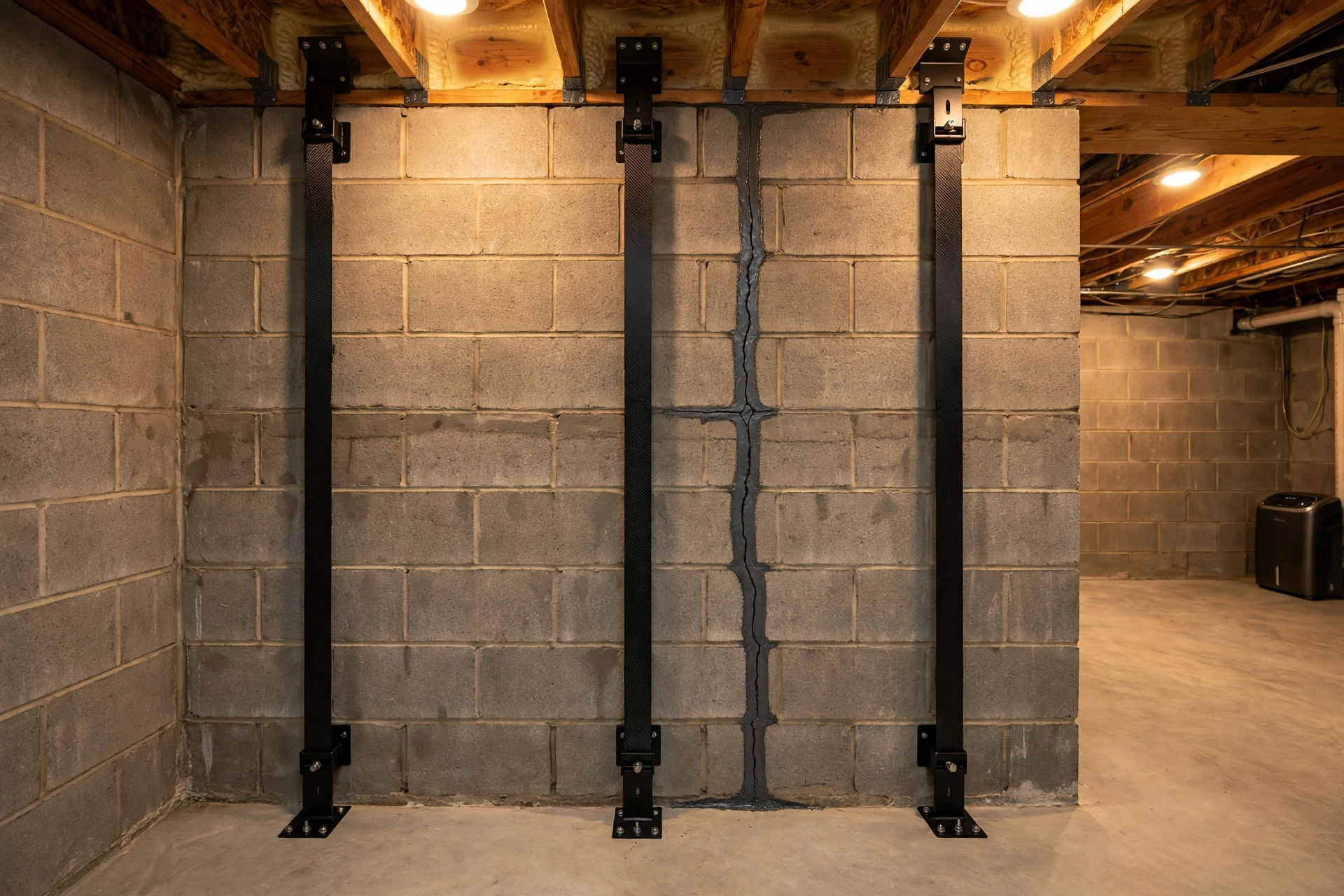
Each strap is woven carbon fiber set into structural epoxy on the prepared wall, running from near the top of the wall down to the footing. Once cured, the strap resists the pull of the soil, so the wall stops gaining bow. Straps are spaced along the affected run, and the top connection ties the wall toward the floor system above.
Preparation decides whether the bond lasts. Paint and loose mortar come off the strap lines, the surface is ground clean, and cracks crossing the strap path are addressed so the bond stays continuous. Finished straps sit nearly flat and can be painted. Structural foundation work in Prince George's County is permit work through DPIE, and foundation repair in Maryland is home improvement work regulated under MHIC, stated here as market facts.
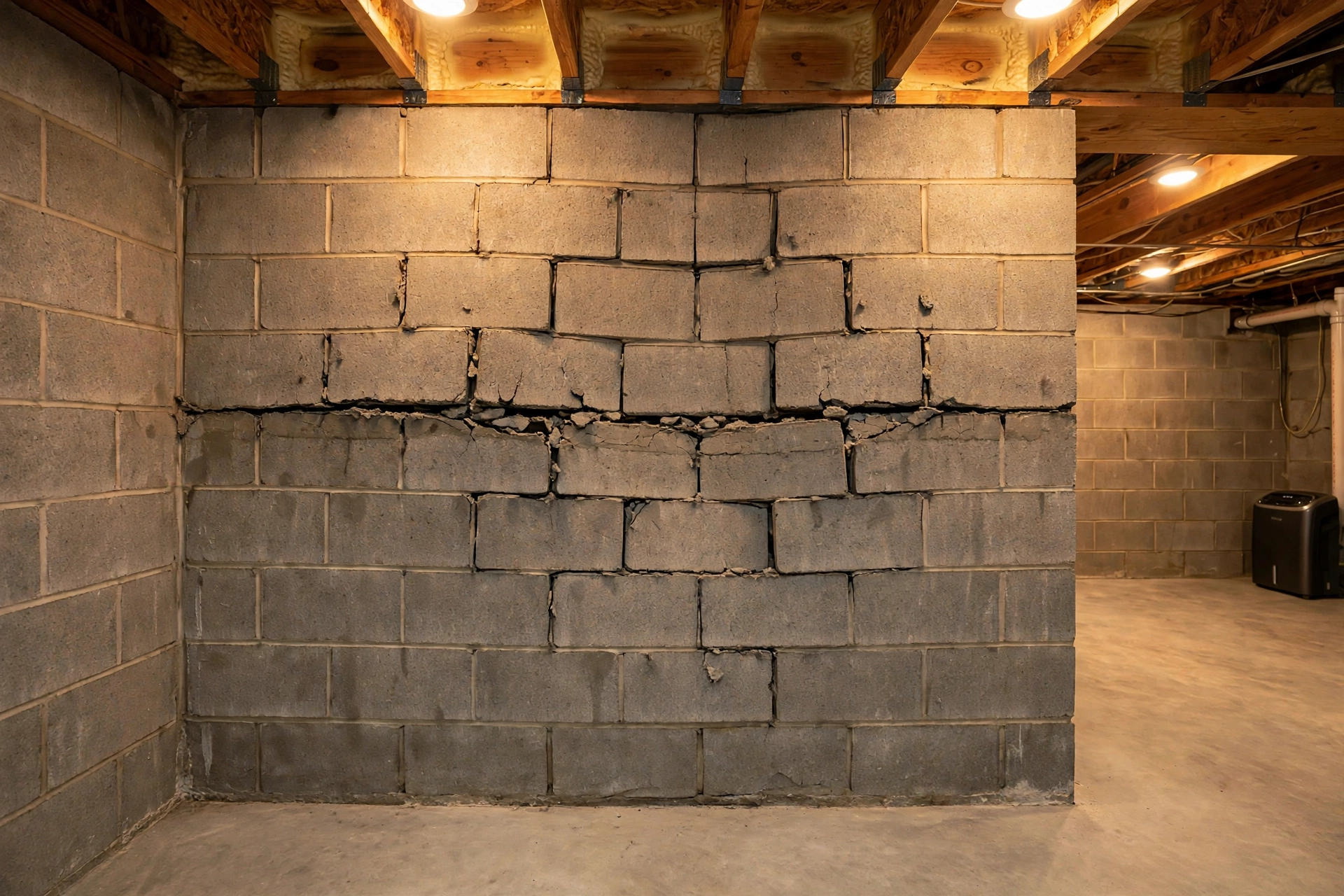
A Chapel Forge block wall had bowed inward along its rear run. A horizontal crack stood open through the middle course, with stair step cracking at one corner. We prepared the wall and fixed eight carbon fiber straps from the top course to the footing. Corner cracks were sealed, and yard drainage was redirected away from that side of the house.
No Bowie company publishes a local price list, so plan from published figures, labeled as published figures. Published figures put carbon fiber wall stabilization in Bowie at $3,400 to $7,800 for a typical residential wall run. The Modernize Maryland table lists a typical foundation repair range of $2,800 to $9,500, and published national guides put the national average at about $5,166 to $5,174.
Where a job lands inside its range turns on wall length, strap count, and surface preparation. A short wall with clean, unpainted block sits low. A long run with heavy paint and open cracks sits higher.
Straps hold a wall where it is. They do not pull it straight, and they cannot rescue a wall that has moved too far. A wall with modest bow and solid courses is a strap candidate. A wall with displaced blocks or a sheared bottom course belongs to steel support or anchors instead.
That sorting protects the budget both ways. Some Bowie walls get quoted for heavy excavation elsewhere when straps would hold them for years.
Published figures put this work at $3,400 to $7,800 for a typical residential wall run in Bowie. Strap count, wall length, and preparation set your place inside that range.
No. Straps hold the wall in its current position and stop the bow from growing. Pulling a wall toward plumb calls for a different system.
Yes. Cured straps sit almost flat against the block and accept paint, so a finished basement can be refinished over them.
Most residential strap jobs in Bowie take one to two days. Surface preparation and cure time drive the pace more than the bonding itself.
They can, where the movement pattern suits them, though block walls are the common Bowie application. Poured walls more often present settlement or shrinkage cracks, which point elsewhere.
Saturated clay pressing against the wall is the usual Bowie driver, made worse by roof water discharged near the foundation. Correcting drainage alongside stabilization helps the repair hold.
Tell us what your foundation is doing. We read every request that comes in and respond with the published range for that kind of work and the next step, starting with a visit to measure the movement and find its cause.
Prefer to talk it through first? Send the form and we will call you back at the number you give us.